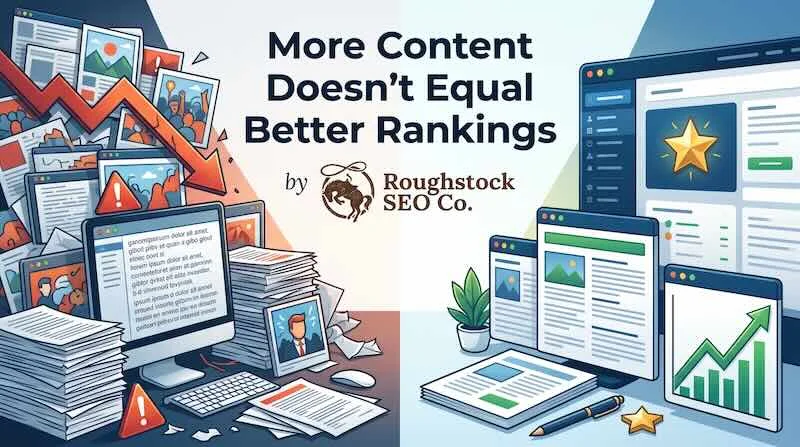
More content doesn't equal better rankings

What this article covers
More content doesn’t equal better rankings, in Google or in AI tools like ChatGPT. Will publishing more content on your website improve your visibility? It depends on the content. Ask yourself four questions about every page:
- Is it useful to the reader?
- Does it accurately answer a question someone is searching for?
- Does it accurately represent your business?
- Would you read it if you were a customer who landed on your site?
If the answer to any of those is no, that service page or blog post wasn’t worth publishing in the first place. A few pages that pass all four will do more for your business than a pile of pages that don’t.
Why Publishing More Pages No Longer Improves Your Rankings
In over a decade of working with businesses, the idea I’ve run into most is that putting out more content will magically increase rankings. Plenty of the business owners I’ve worked with have believed it.
Mass-produced content used to work
At one point, putting out massive amounts of content did drive up rankings. That’s no longer the case.
Today, quantity over quality does nothing for your brand, your website or your presence in search engines and AI tools, except drive it down. It reduces the trust those tools have in your business, and they’re the tools that deliver you customers.
Google is actively fighting spam and thin content, and AI tools aren’t accepting this kind of content as answers. That goes for mass-produced blog posts, service pages and generic location pages, the kind titled “Plumber in [city name]” with the same text on every one.
Google can tell how much effort went into a page
Google is smart enough now to judge how much effort you put into a page, and to score it on how it’s written and how useful it is to the people who read it.
It also watches what visitors do. When a page first goes up, you might see a bump in clicks. But if people land on it, see it has nothing to do with what they were looking for and leave, Google sees that. It keeps it in mind for future rankings.
Could your page be swapped onto a competitor’s website?
Here’s a simple test. Say you’re an electrician and your service area is Largo, Florida. If your page could be moved onto another electrician’s website and nobody could tell the difference, your content isn’t unique enough to get results in Google.
An electrician lost his online presence to copied location pages
I worked with an electrician who’s been in business for over 32 years. His website domain is over 30 years old, and his business is a trusted name in the Clearwater community.
He never updated his website. It had pages for “electrician Largo, Florida,” “electrician Clearwater,” “electrician St. Petersburg” and “electrician Tarpon Springs.” Every one had basically the same content. The only thing that changed was the page title.
That worked for him for a long time. But over the last five years, his presence online was wiped out completely.
To fix it, we rebuilt his website from scratch and got rid of the old one. It took around three months before his traffic started to turn around. Since then, he’s gone from basically zero traffic to climbing in the local rankings. His Google Business Profile now shows in the top four results, and we’re working on getting it into the top three.
I still see business owners following SEO advice that recommends this strategy, and they wonder why they aren’t getting leads from search. Their thinking about it is wrong. Quantity isn’t the answer. Quality is.
How to Create Pages That Actually Help Your Business
Making good content is simpler than most people think. It doesn’t take fancy writing. It takes your business’s real experience.
Make every page unique to your business
Take your service pages, the pages for each service or product you offer. Imagine taking all the text and images off one of them and putting them on your competitor’s website. They should look totally out of place there.
What makes them yours? Your experience, your expertise, the way you do the work and the reasons customers hire you over someone else. Each page should set you up as the authority and the one to hire.
Show your experience, expertise, authority and trustworthiness
Google has a name for this: E-E-A-T, which stands for Experience, Expertise, Authoritativeness and Trustworthiness. Your pages need to show all four.
That doesn’t mean writing something complicated. It means telling the reader what your business has actually done and actually knows. That’s all a page needs to do.
Review everything before it goes live, including AI writing
AI isn’t the problem. I use it all the time, and I used it to help write this article. The problem is publishing without reviewing what’s been written and without asking who it’s for.
If you can’t say who a page is for, it shouldn’t go up, no matter who or what wrote it. I go into this more in Should you use AI to write content for your website?
Go slowly and get it right
If you can publish a lot of pages and keep them all high quality, great. But most well-written pages take time. It’s better to go slowly than to rush and hope for the best.
How to Avoid Hiring an SEO Company That Pumps Out Generic Pages
SEO is a marketing channel built to bring leads and sales into your business. It was never meant to just get impressions and clicks. That’s been twisted over the years, and because SEO is such a technical subject, it’s easy to get bogged down in the details. Don’t let anyone confuse you. Focus on the fundamentals.
Ask how many leads they bring in for their clients
Ask an SEO company how many leads, on average, it brings in for the businesses it works with.
If they answer with impressions or clicks, those are good numbers to track, but they aren’t what you’re paying for. Leads are.
Read examples of their past work
Ask to see pages they’ve written for other businesses, then read them. Does a page look like it could appear on any website in that industry? If so, that’s a bad sign.
Ask what return you should expect and what they’ll deliver
Ask them two questions:
- What sort of return on my investment should I expect from working with you?
- What exactly are you going to deliver to me and my business?
Watch for signs they’re pumping out content on your site
If you already pay someone for SEO, here are signs they may be doing this without you realizing it:
- No keyword research document. They haven’t given you keyword research with a schedule that explains which pages they’re writing and why. That research is where we start every SEO content strategy.
- Blog posts every month with no explanation. Nobody can tell you what each post is for. I explain why that isn’t a plan in Blogs are not an SEO strategy.
- Generic, AI-written pages. The content reads like it could be on anyone’s website.
- It looks off to you. If you read the content and can tell right away something doesn’t make sense, trust that.
Fewer, Better Pages Will Do More for Your Business
Less pages that are written well will do more for your business than a million pages of generic content that can be found anywhere. Before you publish anything, or pay someone else to, ask whether it’s useful, whether it answers a real question, whether it represents your business and whether you’d read it as a customer.